
Most enterprises are deploying AI agents without one. Here’s why that’s the same mistake they made with raw APIs — and what the fix looks like.
An AI Gateway is the governed layer that sits between AI models and enterprise systems — handling authentication, access control, orchestration, and auditability so that AI agents can act safely at scale. Without one, AI agents have the same problem raw APIs had before enterprise organizations deployed API gateways: they’re powerful, ungoverned, and a compliance liability.
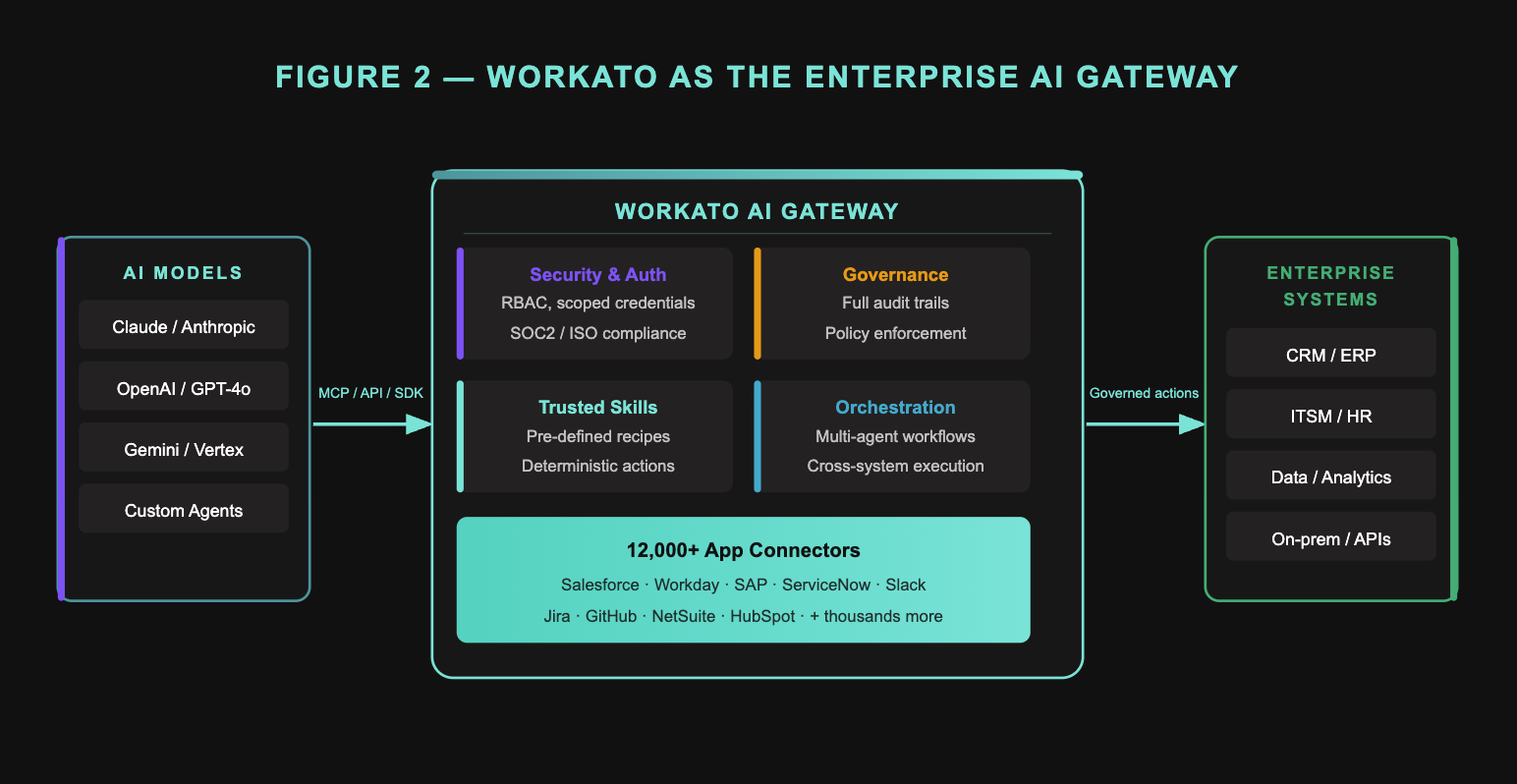
Workato functions as an AI Gateway. It sits between models like Claude, GPT-4o, and Gemini and the enterprise systems they need to act on — Salesforce, Workday, SAP, ServiceNow, Jira, and 12,000 others — ensuring every agent action is pre-authorized, logged, and executed within defined governance policies.
Let’s talk about what an AI Gateway is, why enterprises need one now, and what distinguishes a governance-first AI Gateway from platforms that treat governance as an afterthought.
Why do AI agents need a gateway layer?
AI agents are no longer advisory. They’re actors. A modern AI agent — built on Claude, GPT-4o, Gemini, or a custom model — can open a ServiceNow ticket, update a Salesforce opportunity, query a NetSuite ERP record, and trigger a Workday approval workflow in a single session, without a human reviewing each step. The productivity case is real. So is the risk.
Ungoverned agents create the same problems raw APIs did
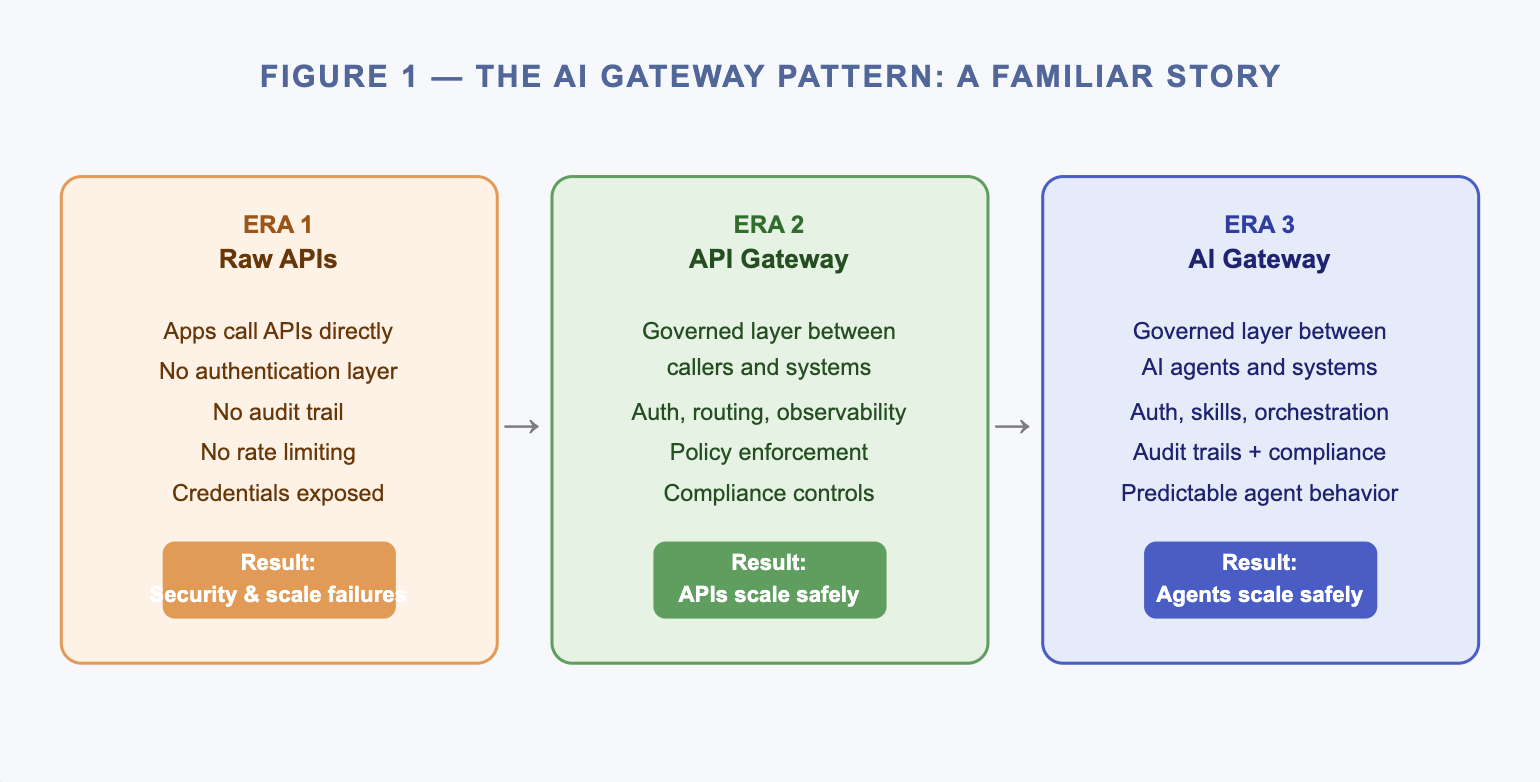
When enterprises first adopted API-driven integrations, raw API access seemed like a breakthrough. It worked — until organizations tried to scale it. Without a gateway, credentials got exposed, usage went unchecked, and there was no audit trail when something went wrong. API gateways became the standard because raw API access was not enterprise-ready.
AI agents face the same structural problem, at higher stakes. An agent with direct, ungoverned access to an ERP or HR system can pull sensitive records outside compliance boundaries, trigger workflows without business context, or take irreversible actions without authorization. Unlike an API call from a known service, an agent’s behavior is probabilistic — it interprets instructions and acts on them, which means outcomes can vary in ways that are difficult to predict or audit.
The risk compounds with multi-agent systems
Single-agent risk is manageable. Multi-agent risk is not… unless you have the right architecture. Enterprises are already moving toward agent networks: specialized systems that divide complex tasks, pass context between each other, and execute long-running workflows across Slack, Salesforce, Jira, and internal databases simultaneously. When an action is initiated by one agent and completed by three others, tracing accountability without a central governance layer becomes nearly impossible.
What does an AI Gateway actually do?
An AI Gateway performs five functions that make AI agents enterprise-ready. Each maps directly to a failure mode in ungoverned AI deployments.
1. It turns raw agent access into governed skills
The most important function of an AI Gateway is replacing stochastic agent behavior with deterministic, pre-approved actions. Instead of giving a model direct API access and hoping it interprets a prompt correctly, a gateway defines a curated set of skills — structured, bounded actions that the agent can call. Each skill always does what it was designed to do, regardless of how the prompt is phrased. We call these Recipes: reusable, AI-callable services that represent trusted enterprise actions, built on connections to 12,000+ applications.
2. It enforces authentication and access control
Every skill an agent invokes through Workato is authenticated against the organization’s identity policies. Agents act on behalf of specific users with scoped permissions — they can’t access systems or records outside the boundaries defined by your role-based access controls. Credentials are never exposed to the model itself.
3. It provides full observability and audit trails
Every agent action executed through Workato is logged — what was called, by which agent, acting on behalf of which user, in which environment, at what time, with what result. For regulated industries, this isn’t optional. It’s a compliance requirement. For all enterprises, it’s the only way to understand and trust what your agents are doing at scale.
4. It orchestrates across systems, not just point-to-point
The most valuable agentic use cases — things like automated customer onboarding, cross-system incident resolution, end-to-end employee provisioning — span multiple applications and require conditional logic, handoffs, and approvals. A gateway that handles only individual tool calls becomes a bottleneck. Workato’s platform was built for orchestration: agents can execute multi-step workflows that touch Salesforce, ServiceNow, Workday, Slack, and custom systems in a single governed sequence.
5. It connects agents to every enterprise system, not just API-first ones
Not every enterprise application offers a clean API. Legacy systems, custom-built tools, and many specialized applications are accessible only through a user interface. Workato enables agents to interact with web-based applications the way a human operator would. This opens the full footprint of enterprise software to agentic automation, not just the API-accessible slice of it.
Does the protocol matter — or just the gateway architecture?
The Model Context Protocol (MCP) is gaining significant traction as a standard for connecting AI models to external systems and data sources. Workato supports MCP, and for organizations building AI agents that need to call enterprise tools, MCP provides a useful common interface.
But the protocol conversation can obscure a more important architectural question: what sits between your AI models and your enterprise systems, regardless of how they communicate?
Why governance outlasts any specific protocol
Enterprises that conflated “API adoption” with “API gateway adoption” built brittle, insecure infrastructure. The specific protocol (REST, SOAP, GraphQL, etc.) mattered less than the decision to deploy a governed layer in front of backend systems. That architectural principle held through multiple protocol transitions and still holds today.
The same logic applies to AI. MCP is one interface. There will be others. The organizations that invest in a protocol-agnostic AI Gateway — one that governs access, enforces policy, and maintains auditability regardless of how the model talks to the system — are making a bet that ages well. The organizations that treat MCP configuration as their sole AI governance strategy could be building technical debt.
Why is governance harder for AI agents than for APIs?
API governance was relatively tractable: a known service makes a known call to a known endpoint. The variables are limited. AI agent governance is structurally more complex, for three reasons.
First, AI agents take multi-step actions. A single agent invocation might touch five systems before completing. The audit trail for that invocation spans a dozen API calls, each of which could have compliance implications. Without a central execution layer that captures the full sequence, the audit trail is fragmentary at best.
Second, agent behavior is non-deterministic. The same prompt, given to the same model, can produce different sequences of actions depending on context, model version, and temperature settings. This means governance can’t rely on knowing in advance what an agent will do — it has to constrain what the agent is allowed to do and log what it actually did.
Third, the consequences of ungoverned agent actions are harder to reverse than failed API calls. An agent that incorrectly modifies a NetSuite record, triggers an out-of-sequence Workday approval, or surfaces restricted Salesforce data to an unauthorized context creates a compliance event — not just a technical error.
Workato’s governance model was designed with this complexity in mind. SOC 2 Type II, ISO 27001, HIPAA, and other certifications extend to the full agentic execution layer — not just the automation substrate underneath it. Policy enforcement is built into how the platform executes, not bolted on afterward.
What makes Workato different as an AI Gateway?
Most platforms that support AI agent connectivity were built for something else first — workflow automation, RPA, iPaaS — and extended to support agents after the fact. The governance model reflects that: agent actions are treated as a special case, with governance features layered on top of an architecture that wasn’t designed for them.
Workato’s AI Gateway is built on top of an orchestration platform that was already enterprise-grade before AI agents arrived. The authentication infrastructure, the role-based access controls, the audit logging, the multi-tenant architecture — these were not added to support agents. They were already there. When Workato extended its platform to support agentic orchestration, governance wasn’t a feature to build. It was the foundation to build on.
The result is a platform where the same governance policies that apply to human-initiated workflows apply automatically to agent-initiated actions. There’s no separate governance configuration for AI. There’s no “AI mode” that bypasses existing controls. Agents operate within the same governed environment as everything else.
This matters most in the multi-agent scenarios enterprises are moving toward — where agent networks divide complex tasks, pass context between specialized agents, and execute workflows across Salesforce, SAP, ServiceNow, and Slack simultaneously. Workato’s orchestration layer governs those sequences end-to-end, not just individual tool calls.
Summary
- An AI Gateway is the governed layer between AI models and enterprise systems — the equivalent of the API gateway for the agentic era.
- Without a gateway, AI agents accessing Salesforce, Workday, SAP, or ServiceNow create the same security, compliance, and auditability problems that raw APIs did before enterprises deployed API gateways.
- A mature AI Gateway provides five things: governed skills (deterministic agent actions), authentication and access control, full observability and audit trails, multi-system orchestration, and connectivity to systems without APIs.
- The specific protocol — MCP or otherwise — matters less than the architectural decision to deploy a governed layer. Protocols evolve; the governance requirement doesn’t.
- Workato functions as an AI Gateway for Claude, GPT-4o, Gemini, and custom models, connecting them to 12,000+ enterprise applications with enterprise-grade security, compliance certifications, and end-to-end orchestration built in from the start.
Workato’s AI Gateway capabilities are part of Workato ONE. Learn more at workato.com/agentic or request a demo today.